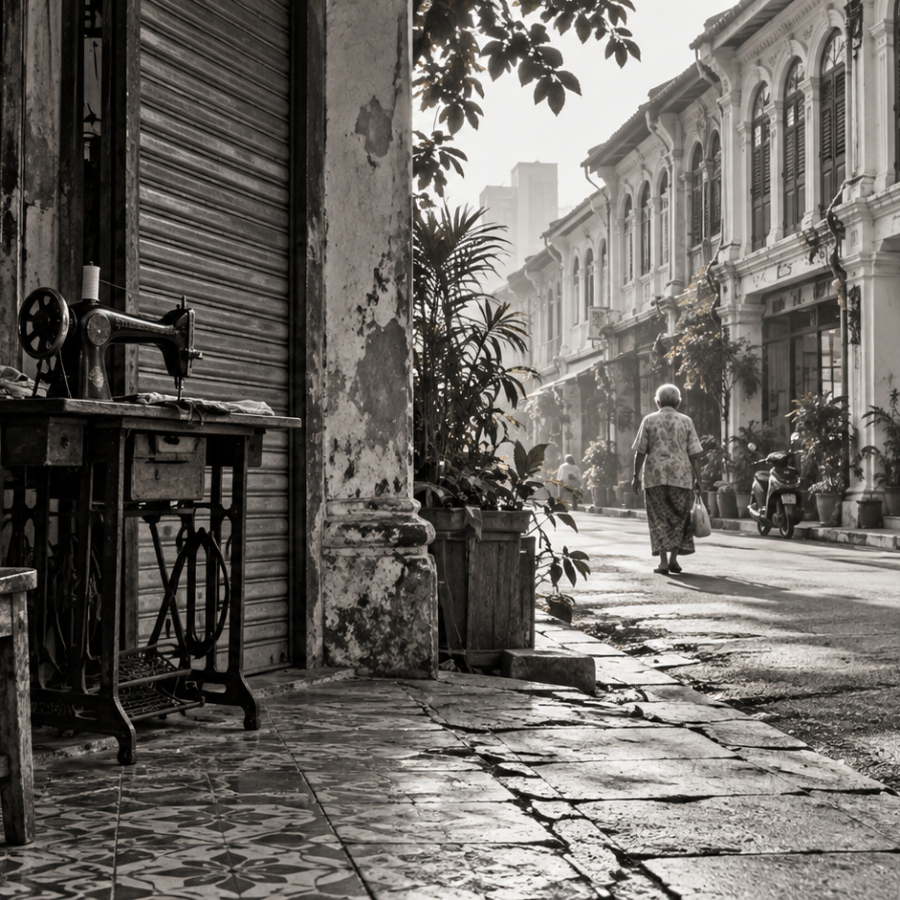
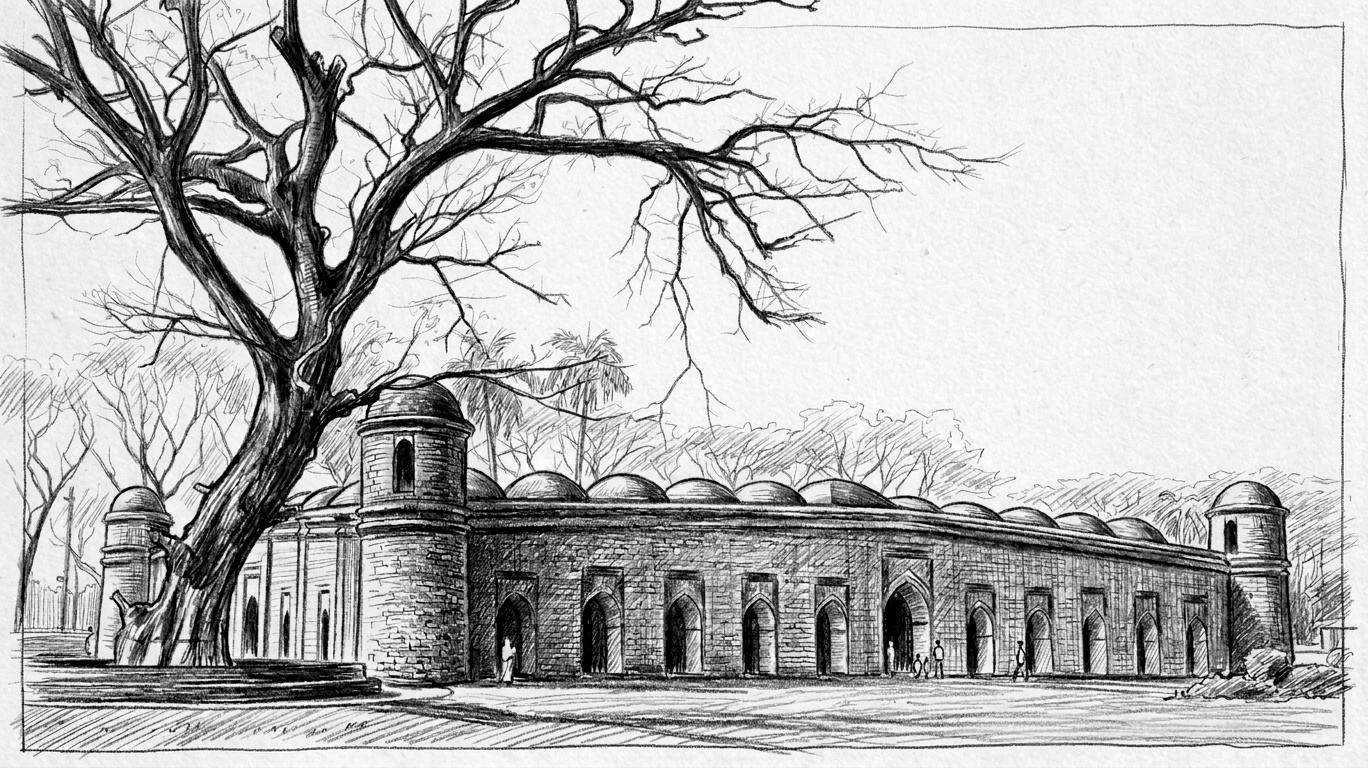
Situated in Bagerhat, Bangladesh, the Shat Gambuj Mosque stands as one of the most important monuments of the Bengal Sultanate period. Built in the fifteenth century under the patronage of Ulugh Khan Jahan, it belongs to the Historic Mosque City of Bagerhat, which became a UNESCO World Heritage Site in 1985. From the outside, its long brick body looks strong and almost severe. Inside, the repeated arches and columns create a different feeling. This contrast is part of what makes the mosque special.
When I first began learning its history, I was interested mainly in its form: the domes, arches, columns and heavy walls. The more I read, however, the more I felt that the building is also about time. It has remained through generations whose everyday lives were completely different from ours. Today, whenever I think about Friday Jumma salat, I also think about that long continuity. Friday gives me a pause from the pressure of the week. Learning that such a place was made to gather people for prayer makes the feeling stronger. It is a quiet way to begin a new week with a fresher mind.
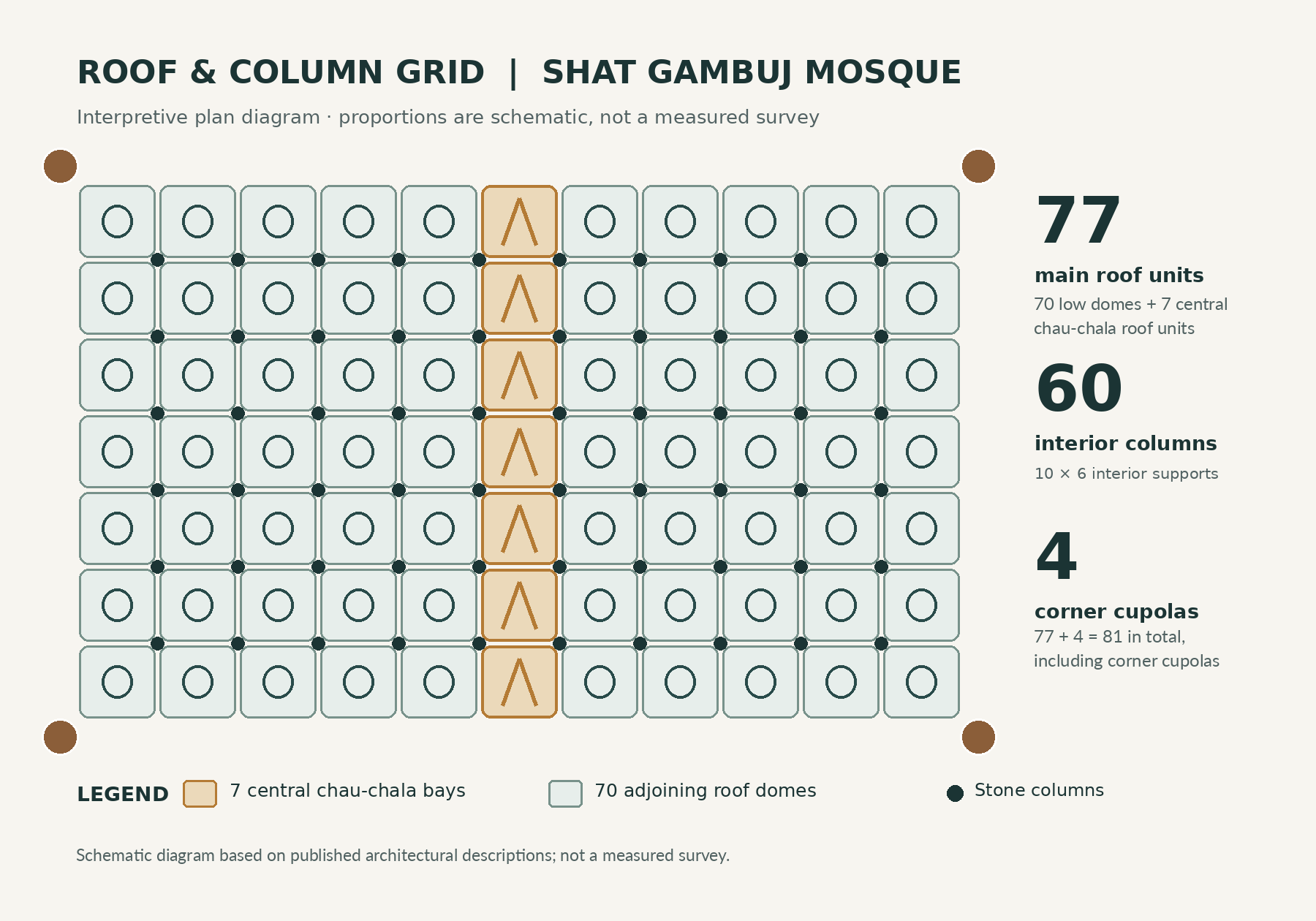
Volumetric & Structural Grid: Sixty Columns, Seventy-Seven Domes
The Shat Gambuj Mosque is famous for a numerical puzzle. Its name means “Sixty Dome Mosque,” yet its main roof is commonly described as having 77 roof units, including seven central chau-chala vaults. The four domed corner towers bring the often-cited total to 81. Inside, 60 stone columns support a regular system of arches. Some explanations connect the name to those columns, though the exact origin of the name remains uncertain.
But counting is only the beginning of understanding it. The hall has seven aisles and eleven bays. Repetition here is doing real structural work. Instead of asking one wide span to carry an enormous roof, the load is passed through many smaller units: vault to arch, arch to column, and column to the ground. That is a simple but powerful principle. The building becomes large because many parts work together.
The grid also has a social meaning. A congregational mosque must allow many people to gather while keeping a shared direction towards the qibla. Rows of columns divide the hall, but they do not turn it into many isolated rooms. People remain within one connected prayer space. The structure creates order without completely closing the space. This is a useful way to see the relationship between architecture and worship: the building must guide people, but not overwhelm them.
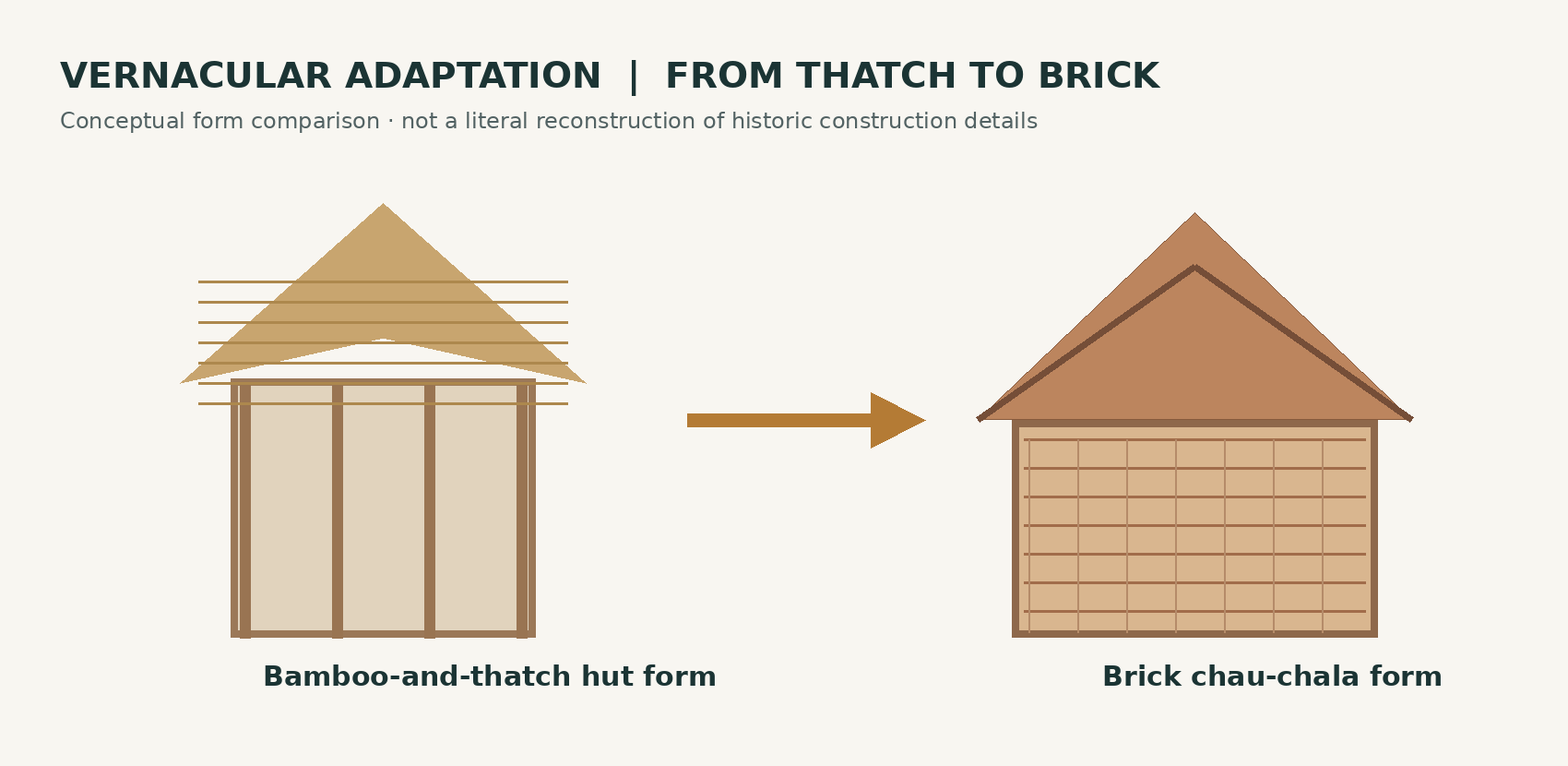
Indigenous Adaptation: From Thatch to Brick
One of the most interesting aspects of the mosque is the use of the chau-chala form. In Bengali rural architecture, sloping hut roofs were developed to respond to heavy monsoon rain. At Shat Gambuj, that familiar roof logic appears in monumental brick form along the central nave. The result is not a simple copy of village architecture. It is a translation. A temporary material logic becomes a permanent architectural one.
This matters because it shows that the mosque is not only a foreign or imperial form placed on Bengal. It is also a local response. The building brings together Islamic monumental architecture and a regional understanding of climate and construction. That synthesis is one reason the mosque feels rooted. It belongs to a wider history of Islam in Bengal, but it also belongs to the land, weather and building traditions of Bengal itself.
This is why the structure inspires me so much after learning its history. The building teaches a quiet but important lesson: strength does not always come from rejecting what is local. Sometimes real strength comes from taking local knowledge seriously and giving it a larger form. The relationship between familiar forms and new materials tells us that architecture develops through adaptation, not just imitation.
Materiality & Atmosphere: Brick, Light, and Ventilation
The beauty of the Shat Gambuj Mosque does not depend on excessive surface decoration. It comes largely from its well-fired brick, thick walls, repeated pointed arches and the careful handling of openings. The eastern front has eleven arched entrances, with seven additional entrances on each of the north and south sides. These openings bring light and air into a hall that would otherwise be very deep and dark.
The physical effect must be considered together with the spiritual use of the place. Outside, a person sees the mass of the building. Inside, attention shifts to the rhythm of the columns, the changing light, and the direction of prayer. The building changes how the body moves and where the eyes look. This is why I find the word “silence” useful in the title. Silence is not only the absence of sound. It can also be the feeling produced by measured space.
Of course, a large number of openings does not prove that the mosque is always cool or perfectly ventilated. Weather, repairs and present conditions matter. The better argument is that the openings were arranged with practical consequences for light and air, while the repeated interior order also shaped the experience of worship. Structure, climate and feeling are linked, but they are not the same thing.
Friday, Memory, and the Duty to Preserve
Friday Jumma salat means something personal to me. It gives me a moment to leave the unfinished things of the week behind, even if only for a short time. I can think more clearly afterwards. It feels like the beginning of a fresh week rather than just the end of an old one. And after learning about the long history of the Shat Gambuj Mosque, that feeling has become more meaningful. I think of people across different centuries making time to gather, stand, listen and pray.
I do not need to claim that my own Friday experience is identical to theirs. Their lives, beliefs and circumstances would have been different from ours. That is exactly what makes the continuity meaningful. A building can connect different generations without making them the same. The mosque does not remove the difficulties of the present, but the history behind it reminds me that people have also lived through difficult times before us. This thought inspires me the most. It makes me stronger in a quiet, ordinary way.
There is also a practical responsibility here. Such a building cannot survive by admiration alone. Brickwork in a humid delta environment needs care, with attention to water, drainage, rising damp and possible salt movement. Conservation should be based on measured conditions, not simply on broad claims about coastal salinity. Repairs that look attractive today can cause damage if the materials are incompatible with historic masonry.
The Shat Gambuj Mosque is therefore not just an object to photograph or a list of domes to memorize. It shows how shared structure, local knowledge, worship and long-term care can meet in one place. The lesson I take from it is simple: strength does not always need to be loud. Sometimes it is the quiet discipline of many parts holding together, week after week and century after century.