
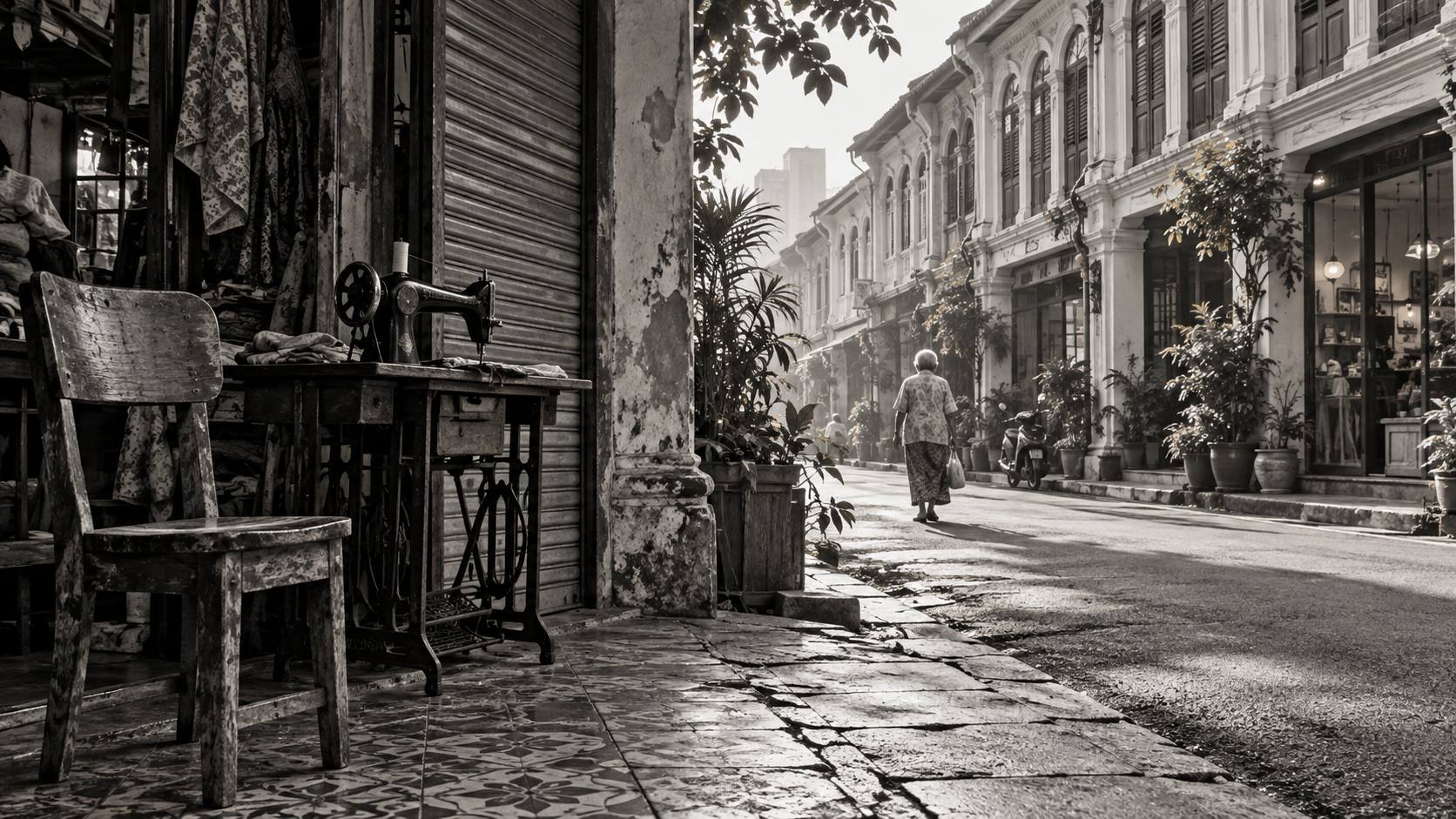
Imagine returning to a street whose old shophouses have been carefully restored. Their shutters are freshly painted, the masonry repaired, the rooflines familiar. Yet the tailor has gone, the grocer has become a souvenir shop, and several upstairs rooms are no longer homes. The scene is hypothetical, not a report from a particular street. It poses a real conservation problem: what exactly has survived when a place keeps its appearance but changes the conditions of everyday life?
A building and a street are not the same heritage object. A building has walls, joinery and construction history. A street also has rhythms: deliveries, worship, purchases on credit, neighbors’ recognition, repeated encounters and access to work. These activities need physical settings, but masonry cannot guarantee their continuation. It is possible to conserve the container while allowing the relationships it once supported to become economically or socially difficult to sustain.
George Town, Malaysia, makes the distinction unusually visible. Together with Melaka, it entered UNESCO’s World Heritage List in 2008, recognized for a multicultural urban landscape of shophouses and townhouses as well as living traditions. The designation did not define heritage as facades alone. It acknowledged everyday cultural practices, religious life and commerce as part of the towns’ significance. That makes subsequent changes to use and residence particularly relevant, rather than merely unfortunate side effects of modernization.
Research by Ruth Foo and Gengeswari Krishnapillai, published in 2019, connects rising property values and rents in George Town’s heritage core to the replacement of some long-established inhabitants and trades by tourism-related businesses. UNESCO’s own sustainable-tourism case study also describes traditional shops giving way to bars, restaurants and visitor-oriented uses, while noting that adaptive reuse has helped maintain buildings and create economic opportunities. The evidence is therefore not a morality play about bad cafes replacing good workshops. Both physical renewal and social displacement can occur in the same street.
Nor is heritage listing the only cause. In a 2024 study, Suet Leng Khoo and Kuan Heong Woo identify both the repeal of rent controls and World Heritage inscription as important turning points in George Town’s housing transformation. Property markets, tenancy law, demographic change, tourism and redevelopment intersect. To say that conservation itself evicts residents would erase those competing forces. The sharper question is whether conservation institutions can protect valued uses when the economic rules governing those uses shift beneath them.
The spatial mechanism is precise. Restoration and recognition can increase the appeal of a historic address. Where stronger demand raises rents or encourages a new use, a tenant unable to absorb the cost may leave. The replacement business may serve different customers, open at different hours, change the relationship between pavement and interior, or require different delivery and storage arrangements. Multiply these decisions along a block and the street’s social infrastructure changes without the loss of a single decorative column. This is a plausible pathway, not a universal sequence.
Such changes matter because ordinary heritage is relational. A neighborhood repair shop is not significant merely because it looks old. Its location near customers, the possibility of small transactions, the skills embodied by its workers and the informal information exchanged at its threshold all connect architecture to public life. Conversely, preserving every old business indefinitely would deny residents the ability to modernize, retire or change professions. Cultural continuity cannot mean compulsory repetition of a vanished economy.
The conservation profession already has language for this difficulty. UNESCO’s 2011 Historic Urban Landscape Recommendation includes land use, social practices, economic processes and intangible values within the urban heritage setting. Australia ICOMOS’s Burra Charter treats use, associations and meanings as elements of cultural significance and encourages compatible use. These principles do not automatically resolve rent increases, but they undermine the excuse that such matters lie wholly outside conservation’s field of concern.
I propose a double-entry conservation account. The first ledger records physical continuity: significant fabric, repairs, alterations, compatible additions and building condition. The second records conditions for social continuity: residential tenure, affordable workspaces, locally useful services, access, trading hours and the survival or transformation of valued practices. Neither ledger should be mistaken for a score of authenticity. They are separate kinds of evidence that should be read together before declaring a historic street successfully conserved.
The approach would require actual investigation. Compare ground-floor uses and upstairs occupancy across time; review rent and tenure changes where lawful and possible; map who can still buy daily necessities within walking distance; interview former and current tenants without assuming their experiences are identical. A facade survey cannot answer these questions, and a few nostalgic interviews cannot establish neighborhood-wide displacement. Changes should be evaluated against documented history, not an invented golden age.
There is a strong counterargument. Without profitable new functions, deteriorating shophouses may remain vacant or become unsafe. Investment, tourism and adaptive reuse can finance repair and keep streets active. UNESCO’s George Town material records those benefits too. The choice is not between untouched tradition and commercial ruin. It is between strategies that count building occupancy as success by itself and strategies that also ask who can afford to occupy the building, for what purposes, and with which public benefits.
Practical responses could include conservation grants tied to demonstrated public value, support for local trades, negotiated leases, housing protections where legally appropriate, and impact assessments that include tenure and everyday services. These are proposals, not guarantees: poorly designed subsidies can benefit landlords more than tenants, and regulation can discourage essential repairs. Institutions would need to track outcomes, revise failures and make residents participants in decisions rather than merely subjects of heritage interpretation.
Return to that imagined row of renovated shophouses. Its photographs might rightly celebrate rescued craftsmanship. But a second set of records should show what happened behind the doors and along the pavement. Heritage is not made safer by pretending that old buildings and old ways of life are identical. It becomes more accountable when conservation asks two questions at once: what has been saved, and who can still make a life there?