
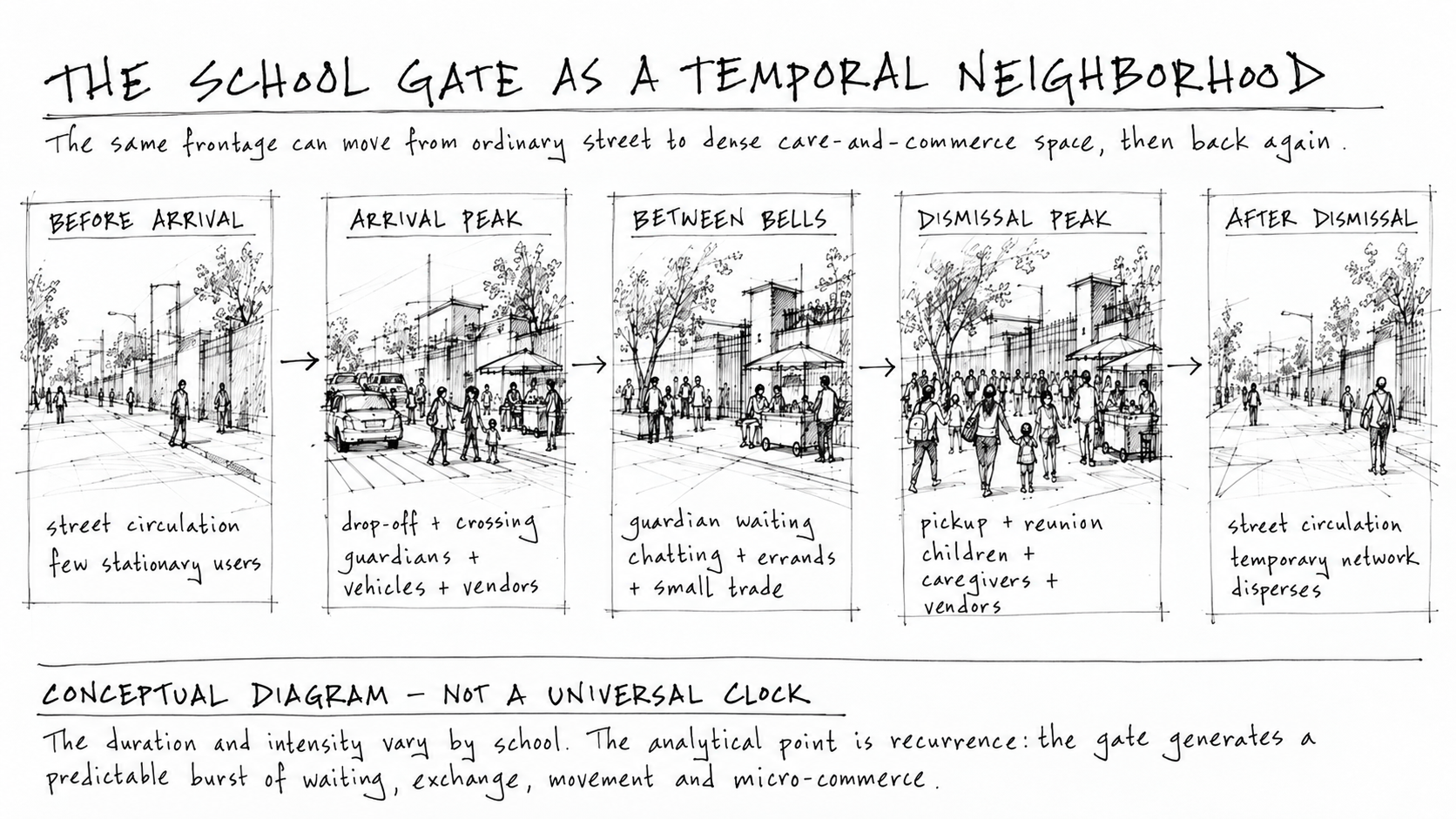
A school gate is easy to mistake for a line in a wall. At 10:30 in the morning it may look exactly like that: a threshold, a guard, a few rickshaws passing, perhaps a vendor waiting for the next rush. Then the bell approaches. Parents and guardians begin to collect along the pavement. Rickshaws stop in places that were moving lanes minutes earlier. Food carts and baskets become more visible. Children pour through the gate. Conversations start, purchases happen, routes cross, people search for one another. For a short period, the frontage becomes denser than many spaces formally designed as public gathering places.
Then it dissolves. The vehicles leave. The vendors thin out. The adults disappear with the children they came to collect. The same street returns to another use. Nothing permanent has been built, yet a recurring piece of public life has appeared and vanished according to the school clock.
One way to understand this is to treat the school gate as a temporary neighborhood. The phrase is deliberately approximate. Not every school gate is occupied for two hours, and the intensity varies by institution, shift, income group, street width and transport pattern. The point is temporal rather than numerical: the gate repeatedly concentrates people who share a schedule, an obligation and a place, producing a social territory that exists more intensely during particular windows of the day.
Dhaka provides unusually clear evidence of this condition. Huraera Jabeen’s 2020 study of gender-responsive public open space observed that adults commonly accompany children because of safety concerns and that mothers often carry this responsibility. When travel time and cost make returning home impractical, some guardians wait in schools, on roads or in nearby open spaces. The waiting is not empty. The study describes mothers using the period to buy household goods, form social groups and, in some cases, conduct small-scale business. It also notes that time-based mobile vendors cluster near schools because the schedule produces a predictable customer base.
That finding changes what the gate means. A planner looking only at movement may see a peak-period obstruction. A caregiver may experience the same place as three hours saved from an extra round trip, a chance to complete an errand, a place to talk with familiar people or simply somewhere to remain until the next obligation. A vendor sees a recurring market. A child sees the edge between institutional control and the city outside. The street is not performing one function badly. It is performing several functions at once, none of which the school building necessarily contains.
The mobility system helps produce this public life. A study of 420 primary-school students from 21 Dhaka schools found that most children travelled with an adult family member, commonly by car or rickshaw, while walking and cycling were limited. Escorting a child therefore creates a second traveller whose time must also be accommodated. In transport models, that adult can disappear into the category of a school trip. On the pavement, the adult remains a body that must stand, sit, wait, shop, shelter from rain, find a toilet, cross traffic and decide whether returning home is worth the cost.
This is why waiting deserves to be treated as a spatial mechanism. Waiting converts mobility into occupation. A moving guardian needs a route. A waiting guardian needs surface, shade, social comfort and a degree of permission to remain. If dozens of guardians wait repeatedly, their presence can support a small economy. If the same people return day after day, weak social ties become possible. Familiar faces begin to recognize one another. Information travels. Children meet outside formal class groups. A location designed as an entrance starts behaving like a neighborhood edge.
Research on school-front public space elsewhere provides a useful comparison. Recent work on ‘school squares’ describes the areas around school entrances as transitional spaces between public streets and the semi-public school domain, used intensively for waiting, socializing and play during arrival and departure. The comparison does not make Dhaka equivalent to those planned school squares. In many Dhaka locations, the opposite condition is more revealing: the social functions exist even when the spatial support does not.
That absence of support matters. Waiting can happen on a comfortable shaded pavement, or it can happen beside moving traffic. A vendor can add convenience, surveillance and social life, or block the narrow strip through which children are trying to walk. Vehicles can provide necessary door-to-door access while simultaneously consuming the very frontage where pedestrians need to assemble. The same concentration that generates sociability can generate exposure, obstruction and stress.
The tension is visible in current policy debate. In March 2026, the prime minister directed the education ministry to explore measures to reduce school-hour congestion in Dhaka, with official discussion focusing on the large number of private cars that gather at some gates during opening and closing. A subsequent interview with BUET transport professor Md Hadiuzzaman argued that guardian vehicles should be kept from reaching gates directly, that school schedules could be staggered, and that catchment-based admission could reduce long cross-city school trips. These proposals begin from traffic capacity, but they indirectly confirm the temporal power of the school schedule: thousands of household routines synchronize around a small number of gates, then spill into the road network at the same time.
The street economy synchronizes too. A 2020 sidewalk study documents a bangle seller outside Ideal School in Motijheel who depended on guardians arriving to drop off or collect children. The location was not accidental. The bell created customers. More recent reporting in 2026 describes hawker congestion around educational institutions in parts of Dhaka, with pressure peaking at the end of the school day. The two accounts should not be collapsed into a simple pro-vendor or anti-vendor position. They show the same mechanism at different intensities: predictable institutional time produces predictable street demand.
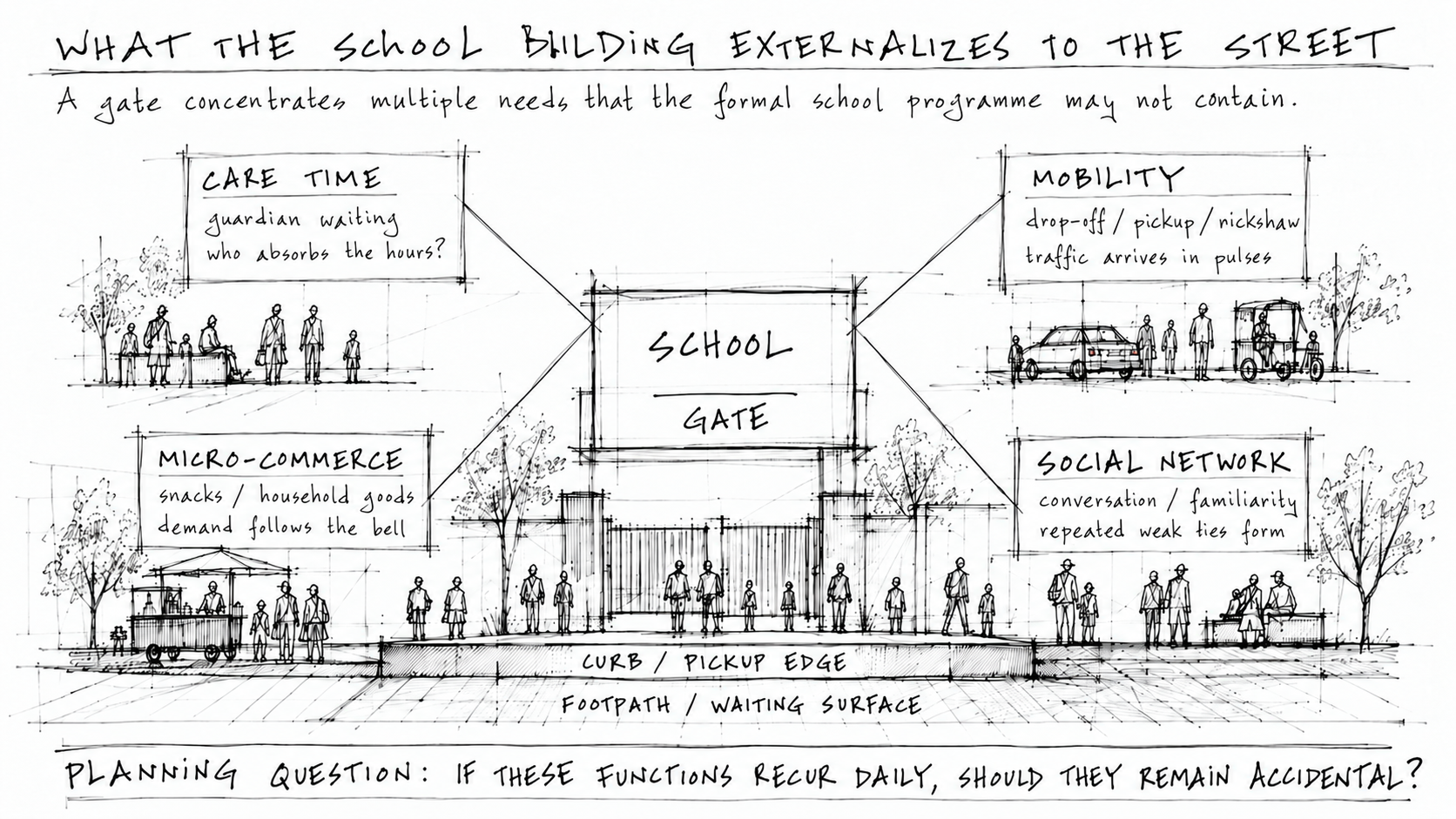
Calling this a temporary neighborhood is useful only if it does not romanticize the reason people are there. A mother waiting beside a school may have found companionship, but she may also be carrying a gendered care burden. A guardian who remains nearby to save a second fare may be responding to household cost, traffic delay or the absence of a safe independent route for the child. A market that flourishes around a gate may support informal livelihoods while making a narrow footpath difficult to use. Social richness can emerge from institutional and infrastructural weakness. The richness does not erase the weakness.
The stronger planning question is therefore not whether school-gate activity should be removed or celebrated. It is which functions are recurring enough to deserve spatial recognition. If hundreds of caregivers must wait, is there shade? Is there seating that does not obstruct walking? Can children reach the gate without crossing a wall of parked vehicles? Is there a toilet within a reasonable distance? Can vendors occupy a defined edge without consuming the pedestrian path? Can pickup points be distributed away from the gate? Does the school timetable concentrate more people than the frontage can safely hold?
These questions shift the design object. The object is no longer only the school building. It is the school-time public realm: the gate, curb, footpath, nearby shopfronts, crossing points, waiting spaces and the short routes that bind them together. Its effective boundary may extend fifty or a hundred metres beyond the institutional plot, depending on where people actually stop and wait.
A useful field method would be simple. Draw the same frontage several times across one school day. Map moving bodies separately from stationary ones. Record who waits, for how long and where. Note when vendors arrive. Count the curb space occupied by pickup vehicles. Mark shade, seating, toilets, crossings and points of conflict. Repeat the drawing when the school is closed. The difference between those maps would reveal the architecture of time that a conventional site plan misses.
Such documentation could also distinguish schools. A neighborhood primary school with many walking children may produce a different public realm from an elite school drawing cars from across the city. A girls’ school may create different waiting patterns from a boys’ school. Morning and day shifts may create separate temporal neighborhoods on the same pavement. The point is not to generalize from one gate, but to make the recurring system measurable enough to compare.
At dismissal, the gate will still look crowded. That crowd should not be mistaken for one thing. It contains care, traffic, commerce, friendship, risk and time. Minutes later, most of it will disappear. The disappearance is precisely why conventional maps miss it. The neighborhood was there, but only while the bell allowed it to exist.