Social inequality refers to the unequal access to safe housing, quality public spaces, essential services, and well-designed environments among different social and economic groups.
High housing costs and unequal development can prevent low-income families from accessing safe, healthy, and adequate housing.
Wealthier neighborhoods may have better parks, schools, hospitals, and recreational facilities than disadvantaged communities.
Buildings and public spaces may exclude people with disabilities, older adults, children, or low-income users.
Investment may concentrate in wealthy areas, leaving poorer neighborhoods with inadequate drainage, sanitation, roads, and public spaces.
Physical barriers, gated communities, and poorly connected neighborhoods can separate social groups and reduce interaction.
Affordable, climate-responsive housing with proper ventilation, daylight, sanitation, and shared community spaces can improve living conditions without sacrificing dignity or environmental quality.
Cultural inequality occurs when the built environment fails to recognize, respect, or represent the identities, traditions, and values of different cultural communities.
Addressing cultural inequality involves recognizing cultural diversity and integrating local history, materials, craftsmanship, spatial traditions, and community needs into design.
Spatial justice refers to the fair distribution of space, infrastructure, public services, environmental benefits, and development opportunities across different communities and geographical areas. Space is not neutral. The location of a hospital, the design of a street, the availability of a public park, or the placement of affordable housing can determine who benefits from urban development and who remains disadvantaged.
Flood-prone or remote communities need elevated housing, raised walkways, accessible cyclone shelters, and multipurpose community facilities. These interventions can improve safety and access for people who are often underserved by conventional development.
Local residents should be involved in planning and design so that their needs, experiences, and aspirations shape the built environment.
Cultural and Environmental Sensitivity
Respect local identity, climate, landscape, traditional knowledge, and available materials.
Equitable Spatial Planning
Distribute parks, public facilities, transport, and infrastructure fairly, prioritizing underserved communities.
The location of buildings, distribution of facilities, design of public spaces, and treatment of cultural heritage influence people’s access to opportunities and their sense of belonging.
Identity in Society, Culture and Spatial Justice
Identity is the sense of who we are, where we belong, and how we relate to other people and our surroundings. It is shaped by social relationships, cultural values, history, beliefs, lifestyle, and the physical environment.
Identity is not limited to an individual’s personal characteristics. It is also expressed through buildings, streets, neighborhoods, public spaces, and landscapes. The built environment can reflect a community’s identity, strengthen its sense of belonging, or create exclusion when certain groups and cultures are ignored.
People identify with places where they feel accepted, safe, and connected. Streets, parks, courtyards, and community centers create opportunities for people to meet and build relationships. Housing types, building locations, and access to facilities can influence how people are perceived in society.
Identity is created and expressed through the relationship between people, culture, and space. Buildings and urban environments are not merely physical structures; they are places where social relationships develop, cultural memories are preserved, and collective belonging is experienced.
Social identity explains how people connect with communities, cultural identity explains how values and traditions shape places, and spatial justice addresses whether these identities are recognized and respected in the distribution and design of space.
A shared courtyard in a residential neighborhood can provide a place for children to play, neighbors to interact, and community relationships to develop.
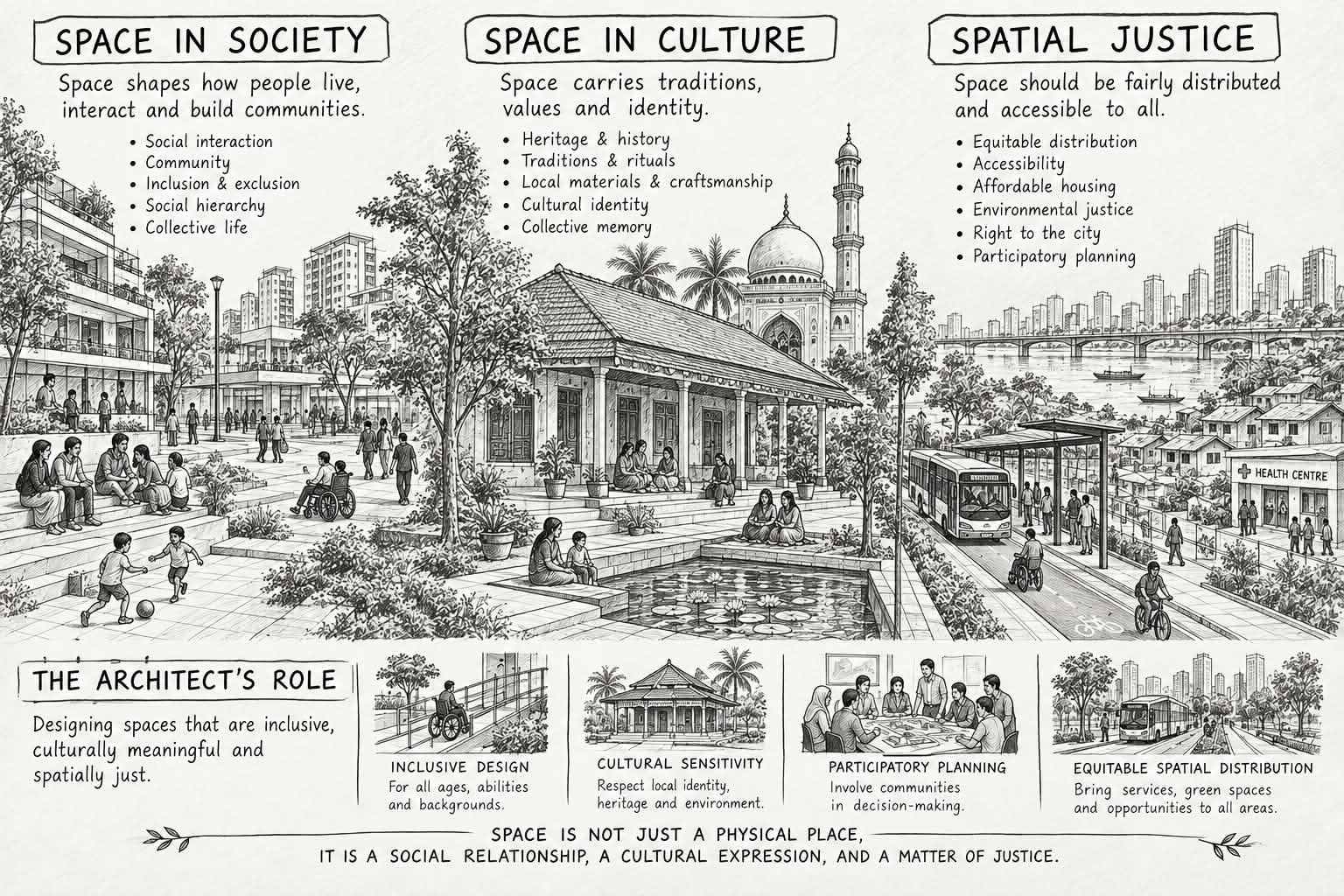
Space in Society, Culture and Spatial Justice
Space is not merely a physical area enclosed by walls, buildings, or boundaries; it is also a social, cultural, political, and economic construct. The way space is designed, organized, distributed, and used influences human behavior, social relationships, cultural expression, and access to opportunities. Space is both a physical setting and a medium through which society expresses its values, culture preserves its identity, and justice or inequality becomes visible.
Space in society refers to how physical environments influence social relationships, human activities, community structures, and power relations. Society produces spaces according to its needs, values, economic conditions, and social hierarchies. At the same time, these spaces influence how people interact and behave.
Space in culture refers to the relationship between physical environments and the beliefs, traditions, lifestyles, values, and identities of a community. Culture influences how people understand, organize, occupy, and give meaning to spaces.
A space becomes culturally meaningful through human activities, shared memories, rituals, and historical experiences. A traditional Bengali courtyard provides a multifunctional space for family interaction, household activities, ventilation, and social gatherings. Its significance is not limited to its physical form; it also reflects local lifestyles and social relationships.
Similarly, the spatial arrangement of a mosque supports collective prayer, community gathering, and a shared spiritual experience.
Culture gives space meaning, while space provides a setting in which culture is practiced, preserved, and transmitted. Spatial justice examines whether people have fair access to the spaces and resources necessary for a dignified life. It also considers who makes decisions about space, whose interests are prioritized, and who experiences the negative consequences of development.
Space is more than a physical container for human activities. It is a social product, a cultural expression, and a medium through which justice and inequality are experienced. In society, space influences interaction, power, and belonging. In culture, it preserves traditions, values, and collective memory. In spatial justice, it determines how fairly people access resources, services, and opportunities.
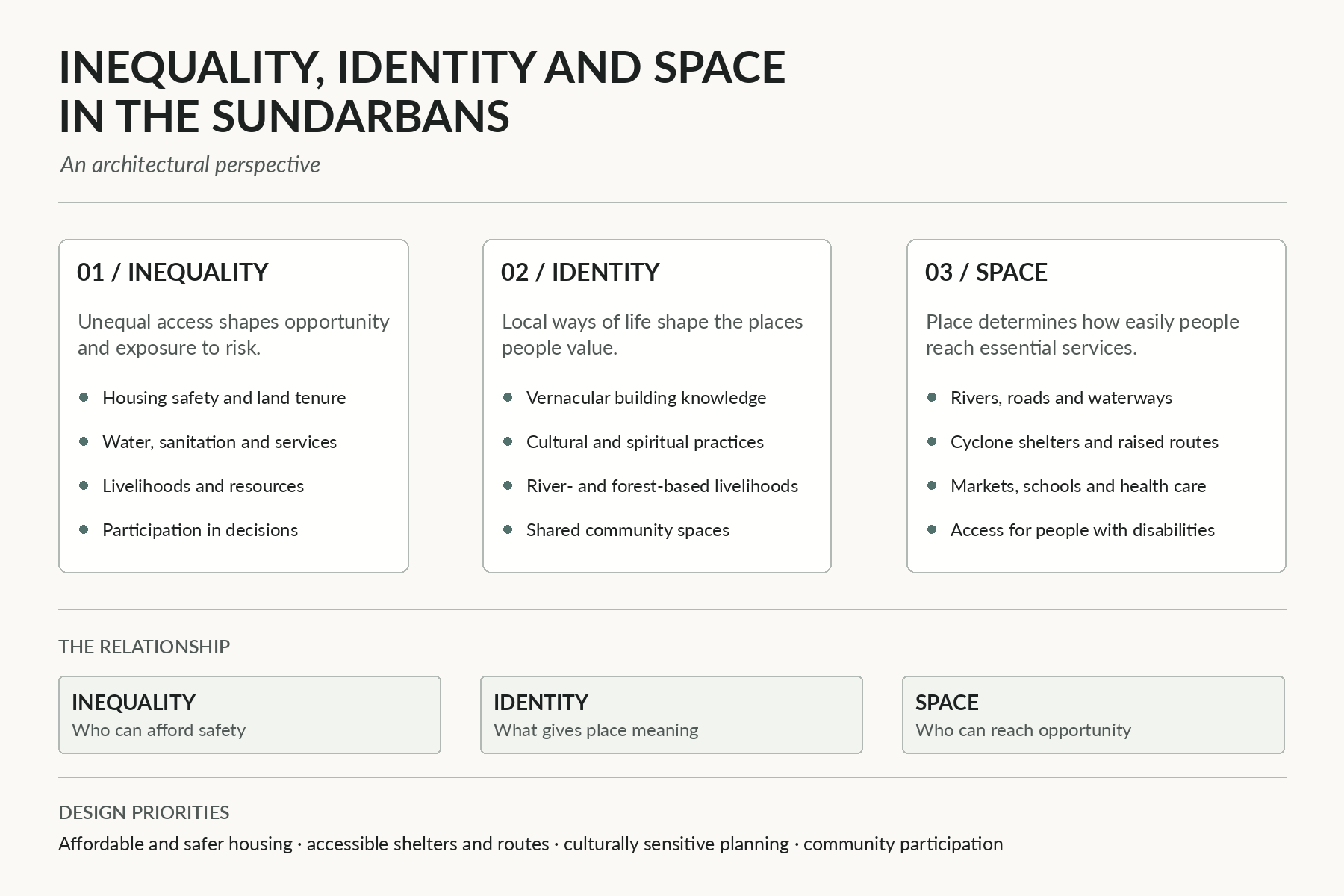
Sundarbans
The Sundarbans is more than a natural landscape. It is a complex human–environment system in which housing, settlement patterns, infrastructure, cultural practices, and ecological processes shape people’s everyday lives.
The relationship between inequality, identity, and space is visible in the way people access land, construct homes, use public spaces, protect themselves from cyclones and floods, and maintain their connection with the forest and rivers.
Housing is one of the clearest physical expressions of inequality. In communities surrounding the Sundarbans, differences in household income, landownership, employment, and access to construction materials influence the quality, durability, and safety of homes.
Households with greater financial resources may be better positioned to build stronger structures, raise their floors, improve sanitation, and recover after a disaster. Low-income and landless households may have fewer options for improving their homes or relocating from hazardous areas.
From a planning perspective, accessibility depends on more than distance. It also depends on travel time, transport availability, road and waterway conditions, affordability, disability access, and safety. A cyclone shelter may provide substantial protection during a storm, but its effectiveness is reduced if residents cannot reach it safely or if it does not adequately accommodate women, children, older people, and people with disabilities.
Climate-responsive architecture must be both environmentally appropriate and economically accessible. A technically resilient building that local households cannot afford to maintain does not fully address spatial justice.
Religious and cultural beliefs influence how people understand and use particular places. In the Sundarbans, traditions associated with Bonbibi demonstrate how the forest can be understood not only as an economic resource but also as a culturally meaningful landscape.
From an architectural perspective, cultural identity can be expressed through shrines, gathering places, village courtyards, local markets, and other spaces where community relationships are maintained.
In the Sundarbans region, settlement patterns are influenced by waterways, agricultural land, embankments, soil conditions, and exposure to environmental hazards. These factors affect where houses can be built and how residents access essential facilities.
Inequality determines who can afford safe housing, reach public facilities, and recover from environmental disasters. Identity influences architectural form, settlement practices, cultural heritage, and people’s attachment to the landscape. Space determines how resources, services, opportunities, and environmental risks are distributed.
For architects, the challenge is to create buildings and settlements that are simultaneously socially inclusive, culturally meaningful, environmentally resilient, and economically accessible.